The Mathematics of the Christmas Rush: Why ‘One Last Push’ Guarantees You’ll Be Late
It is the first week of December. The Board meeting is looming. The sales team is asking about that “one critical feature” promised for Q4.
As a Head of Engineering or CTO, your instinct is to rally the troops.
You ask the team to dig deep. You squeeze a few more tickets into the sprint. You aim for maximum efficiency to get it all done before the holiday break.
In your head, this feels like strong leadership. In Operations Science, this is a mathematical error known as the “Utilisation Trap”.
By pushing your team from “busy” to “maximum capacity” this month, you are not securing your Christmas delivery.
You are mathematically guaranteeing it will be late.
Here is the physics behind why the “Christmas Rush” almost always fails.
The Intuition Trap: Resource Efficiency vs. Flow Efficiency
Most organisations manage for Resource Efficiency. This means the goal is to keep every developer, QA, and designer 100% busy. If someone has a spare hour, we find them a ticket.
It looks efficient on a spreadsheet.
But software delivery behaves like traffic on a motorway, not like a factory assembly line.
- When a motorway is 50% full, traffic moves at the speed limit.
- When it is 95% full, traffic stops.
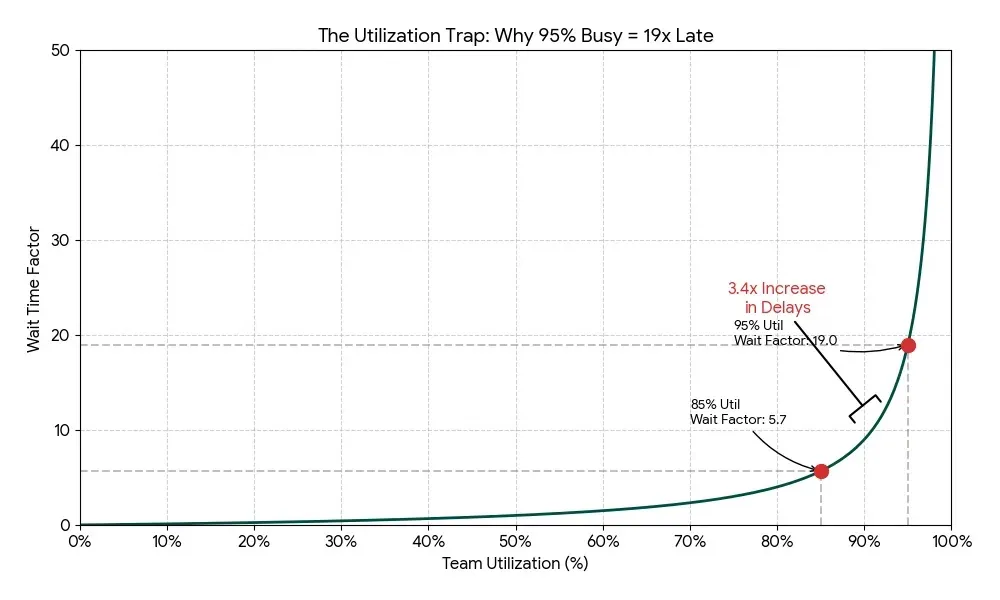
The same applies to your engineering flow. The “busyness” of the team (Utilisation) is directly linked to the time it takes to ship code (Wait Time).
This relationship is governed by Kingman’s Formula.
The Maths: Kingman’s Formula
Kingman’s Formula is the primary law of queueing theory. It proves that wait times do not grow linearly; they explode exponentially as utilisation approaches 100%.
The simplified relationship looks like this:
Wait Time Factor = Utilisation / 1 - Utilisation
This formula tells us that a small increase in load does not create a small increase in delay. It creates a massive traffic jam.
The Calculation: The Cost of the “Christmas Push”
Let’s look at a real-world scenario we often see when auditing scaling tech teams in December.
Scenario A: The Sustainable Pace (85% Capacity)
Your team is working hard. They are utilising 85% of their available time for project work, leaving 15% for slack (unexpected bugs, context switching, meetings).
- Utilisation: 0.85
- Wait Factor: 0.85 / (1 - 0.85) = 5.6
Scenario B: The Christmas Rush (95% Capacity)
You ask for “one last push.” You fill every gap in the calendar. You push utilisation to 95%.
- Utilisation: 0.95
- Wait Factor: 0.95 / (1 - 0.95) = 19.0
The Result
By trying to squeeze just 10% more work out of the team, the maths says your projects will sit in queues 3.4x longer (19.0 / 5.6).
You are trading a tiny theoretical gain in “busyness” for a massive, guaranteed breakdown in speed.
The Socio-Technical Cost
The maths is bad enough, but the human cost is worse.
When the system jams (due to Kingman’s Formula), work stops flowing.
But the deadline doesn’t move.
This forces your Engineering Managers and Senior Engineers into “Firefighting Mode”.
They abandon good process to force tickets through the bottleneck:
- Code reviews get rushed.
- Technical debt piles up (to be paid in January).
- Psychological safety collapses because the team feels they are working harder than ever, yet delivery is slower than ever.
This is why January is the peak month for senior engineer resignations. They aren’t leaving because they dislike the work; they are leaving because leadership ignored the physics of the system.
The Intervention: Be the Shield, Not the Hammer
If you truly want to maximise the ROI of your engineering salary spend this December, you must do the counter-intuitive thing.
You must lower the utilisation.
- Cap WIP (Work In Progress): Identify the 2 or 3 absolute “must-haves” for December.
- Freeze the Rest: Ruthlessly pull everything else out of the active sprint.
- Drain the Queue: By dropping utilisation back to 80-85%, you reduce the “Wait Factor,” allowing the critical items to flow through the system at speed.
You cannot fight physics with “hustle.” If you want to finish fast, you have to stop trying to do everything at once.
Is your Q1 Plan doomed by Kingman’s Formula?
Most scaling companies plan their Q1 headcount assuming 100% capacity, meaning they are building delays into the budget from Day 1.
At Capra Leadership, we combine the Psychology of People with the Physics of Flow to build engineering organisations that are mathematically efficient and culturally resilient.